Showing posts with label WFTDA. Show all posts

Tuesday, April 16, 2013

Mad Skills


Change is hard.

The new WFTDA minimum skills requirements were released yesterday and already there are a lot of opinions. Apparently there are some people looking down on skaters who may struggle with these skills, which I've seen less of, and others who feel these requirements are setting the bar too high. 

This year is seeing a lot of new changes in the way tournaments and rankings are organized, the updated rules and now the MSR revision. This is an important time in Roller Derby because we are growing immensely, and with that we have to respond to growing pains. People wanted more competitive, evenly matched bouts and the WFTDA responded with Divisions. People complained about slow derby and the rules, and minors were done away with in the newest version of the rules, leaving a faster, harder game. People boast about the athleticism of the sport now, and wanting to be taken seriously, and I feel that raising the bar on what skills skaters should have is necessary to keep propelling our organization. 

These skills weren't just pulled out of a hat nor did they time Bonnie Thunders on laps and declare that the new standard. The skills were voted on and tested by member leagues, which means they're realistic and doable. As a middle of the road league, we've played some very high competition and it can be quite terrifying. I remember in 2011 I was pretty certain I was an awesome skater and there wasn't much more I could learn, and then we played a version of the Minnesota Rollergirl All-Stars and my world was rocked. The only way we can advance as leagues and skaters is to push ourselves and set goals that will bring us to a high level of competition. 

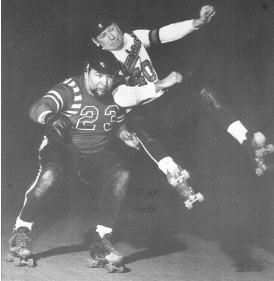
I don't generally practice skating on one foot, but having a diverse set of skills has me prepared for almost anything. Photo by Danforth Johnson.
Some of the concerns that have been put out there are that this will discourage new skaters, that it will hurt smaller leagues and that WFTDA is being exclusive. I think people are blurring the edges of what roller derby is as a whole and what becoming a WFTDA member league means. 

The first thing to keep in mind is that these requirements are for chartered skaters playing WFTDA bouts. Leagues can set their own standards for leveling up new skaters, home team skaters, or B team skaters. Hopefully leagues were already setting a higher standard for their All-Star and charter teams. Putting a skater on the track with only the old minimum skills is unsafe for the skater and others, and they become a liability to their team. With these higher standards, it should bring a cohesiveness to your roster and a clear vision of what sort of game you should be bringing to the track every bout. 

These updated skills can't, and shouldn't be ending Roller Derby for any leagues out there. For non-WFTDA leagues, it is another reason to work hard and earn a status as a member-league. For newer WFTDA leagues, you had a voice in this decision, and any concerns should have been voiced previously. Your voice doesn't end there either, the WFTDA is open to feedback on published things as they were about the recently revised rules. Non-sanctioned games can also be played until the skills are passed, so there is no reason to say that this is a career ender. If this is what is going to discourage people from staying committed, then I think there are other issues at hand. 

Most people don't know what they can do until they try something new. At the gym our league works out in, we sometimes do box jumps. The tallest box they have is 26 inches which I can do fairly easily. Our trainer saw that some of us reached our max height and started adding 3" thick weights on top, starting with one. I looked at it, feeling fairly sure I could do it, and I did. He added another. This was more daunting but I made it, barely. He put a third one on and I was almost certain it would be impossible. I jumped, and probably faltered the first time, but did it again until I could do it steadily. It's amazing what people can accomplish when they come face to face with a challenge. Like this guy...

We have got to be pushed and encouraged to do new things or we will never know what we are capable of. These skills will be a challenge, and there are some people who will probably never ace them. A place on a charter should be an earned spot, not a given, and competitive skating is what we should strive for. To put on entertaining bouts and make money, to promote our sport and be taken seriously, we have got to put a good product out there and to do that we have to raise the bar.

Roller Derby is an all inclusive sport, and you can find a spot for pretty much anyone interested in joining. Becoming a WFTDA league means playing high level derby, representing the face of competitive play, and encouraging growth and development. I suppose you could call that elite, but I see it as more of adjective than a noun. We should all want to be and play the best of the best.

My last concern is hearing all of this outcry within the first 24 hours of the minimum skills being released. Have you even tried them yet? As I mentioned, there has been a lot of change in only the last four months. Bouts haven't really picked up until March, so much of this stuff has yet to really been played out and seen for what it is. We are all in this together, and we all want to play really great Roller Derby. Do me a favor, please stop being so negative, no matter which "side" you are on, and lets work together to figure out what is best for our future.

-L4D
P.S. This is what a reverse crossover looks like:


WFTDA's MSR Release
Regarding Rule 1.1
Little Anecdote - "New WFTDA Minimum Skills - let's chat."
Moxie McMurder on Lead Jammer Magazine - "New Minimum Skills Highlights the Dark Side of Derby"
Gin & Fishnets - "The New WFTDA Minimum Skills"
Electra Q-tion - "The New Minimum Skills...and?"
A newer skater's perspective: Meg on Skates 
Booty Quake from Roller Derby Athletics - "They're New But Are They Improved?"

Monday, December 6, 2010

Roller Derby (R)evolution.

When I tell people I play roller derby I often get a range of confused reactions. There’s the “Really?? You get to elbow girls and stuff?” or the “Wow, that’s so cool! Do people get hurt a lot?” and you can’t forget the blank stare “What’s that?” In the last year though, I’m more likely to get a “Oh! Like in Whip It?” At first I would just kind of nod my head but explain that we play flat track and it’s a bit different, and plus that movie didn’t really highlight the …well never mind. Eventually I just started saying “Yeah! Like the movie...”

I know I have turned into a bit of a derby snob and am just a wee bit tired of answering the same uninformed answers again and again, but I have to remind myself that the general public just doesn’t know any better. Roller derby is so new (I feel like I say this every post) that the small percent who may know what it is, may not know everything about it or even that there are multiple organized versions of modern derby. I didn’t even know this until recently and it kind of gives some insight into how the prevalent form, flat track roller derby, got to where it is today.

First let me give a brief history lesson that I learned from my derby bible, (Down and Derby) and set up the scene for modern roller derby. It was first trademarked by Leo Seltzer in 1935 when he combined dance marathons and roller skating and came up with a marathon roller race. Within the Chicago Coliseum people would skate the distance between New York and LA through laps on a banked track. By using both male and female competitors, he hoped to draw in more of a crowd, but it was seen more as a show instead of a sport. Add a little contact and a dramatic storyline and it was perfect for television starting in ’48. Leo passed the business to his son, Jerry, in 1959 and after a few rises and falls, it died in 1973.

Spandex. Blades. Elbows.
Welcome to RollerJam.
Enter the 80s. TV revived roller derby once again with an awkward love child of professional wrestling and American Gladiators, on skates. Rock-n-Roller Games was pure kitschy entertainment again with co-ed competitors and a banked style track and… an alligator pit? (Still can’t wrap my mind around that one.) That didn’t last long and then it popped up again in the 90s, but this time on rollerblades. RollerJam was seen more as sports entertainment, but still heavily scripted and corny.

All of these early versions of derby were motivated with the goal to sell a new version of entertainment and was often reliant on fickle television viewers. In the end, the melodrama outweighed the skill and people got over it quickly.

Finally in 2001 the beginnings of flat track roller derby began as some girls in Texas threw together a rough version of the game. Looking to the past they collaged together an all girl roller derby team that played on quad skates and a flat track. As a skater run endeavor, there was no third party to front the money to play or sign a television contract, the girls had only themselves to pull it off. Since a banked track is costly, time intensive to set up and needs to be stored, they adjusted the game to a flat track so they could play virtually anytime on any smooth, open surface.

After a few years of fine-tuning what began as a sport with a hint of sexy entertainment, roller derby began streamlining into the athletic version that is most practiced today. In 2004, with about 20 teams on the scene, the Women’s Flat Track Derby Association formed, and girls everywhere had a support system to look to when starting a team. 2005 began the first official set of WFTDA rules for flat track roller derby and has been updated every year to maintain a safe and fair skating environment as the sport evolves. To date there are 105 full member leagues and 46 apprentice leagues throughout the states, Canada and Europe as well as hundreds of WFTDA aspiring leagues all over the globe.

Anything goes in Renegade derby.
The first variant form of derby since the turn of the century would be Renegade leagues. In 2004, members of one of the earliest flat track teams, the Arizona Roller Derby, broke off to form the Renegade Rollergirls. This version essentially skates by no rules except for an aggressive Golden Rule standard and an “any surface anytime” motto. It was created with the desire for a fast paced game that wasn’t weighed down by penalties and highlighted the skaters’ skills. Three points are scored per lap, all sorts of blocks are allowed and refs aren’t needed. It results in a less complicated version of the game with an all out brutal twist. As of 2009 there are seven renegade teams.

In an effort to incorporate the older style of roller derby, the Old School Derby Association was formed in 2007 by the Penn Jersey She Devils. Combining older banked track with today’s flat track, they also aspire to have a less complicated game at high speeds, with aggressive action. OSDA developed a rule set in 2008, and can be played by men, women, and co-ed teams on banked or flat track.

The basic idea of the game is similar but the roles of jammer and pivot becomes a bit more interchangeable. After the first lap through the pack the jammer becomes “active” and can begin scoring points. Lead jammer status can change throughout the jam as it goes to which ever jammer is physically in the lead at the time. The pivot may take off and become jammer at anytime, especially if their jammer is in the box, but only one person may be scoring points at a time. The old school twist allows for triceps to be used in blocks, spin whips, and pivot blocks. (I still haven’t really figured out what the latter two really are…) Cutting the track, high/low blocks, tripping, and out of play penalties are all considered minors and result in one minute in the box. Things like deliberately pulling skaters down, fighting, biting, choking and kicking are majors and put a skater in the box for two minutes. An accumulation of eight penalty minutes ejects a player from the game. Currently eight leagues take part in the OSDA derby style.

Around that same time, Pioneer Valley’s Dirty Dozen, the New York Shock Exchange and Harm City Homicide, three men’s leagues, started the Men’s Derby Coalition to aid the interest men had in the flat track world. They don’t claim themselves to be a governing body yet, or associated directly with OSDA or WFTDA but do train and play by WFTDA standards. They started out playing alongside women, in exhibitions bouts at women’s bouts and scrimmaging against women, until they finally began holding their own double headers and tournaments. With about 11 MDC affiliated leagues they have their own tournaments and rankings within their growing support system.

This Is How I Roll - Working Trailer from Kat Vecchio on Vimeo.

A trailer for a documentary on men's derby and the opposition they face.

When Texas gave birth to modern roller derby, she really had two children. A split in the original revival resulted in two teams; the Texas Rollergirls, who remained flat track and the Texas Lonestar Rollergirls, who progressed as banked track team. Since then, a few more banked teams have popped up, but that trend remains slow and steady. The effort and space required for having and maintaining a banked track looks time intensive, and these teams often start as flat track teams until they have the means to switch to banked track. A recent visitor to our practice, Emma Grenade, came from the Arizona Derby Dames who recently made that switch. Her first time practicing flat track must have been quite the experience on our super slick floor, but the transition wasn’t too difficult for her. The World Organization of Roller Derby designed their banked track rules to be compatible with WFTDA rules so that skaters and refs may participate in either without being bogged down with too many differences. They play one minute jams, use their tricep to block, and skaters don’t visit the penalty box until after the jam ends. They also aren’t allowed to stop or skate backwards on the track for all you fans who are offended by “slow derby”…
Whip It featured banked track derby.

Some leagues like the San Diego Derby Dolls play both flat and banked, while others like the LA Derby Dolls play purely banked track. Episode #31 of the Derby Deeds podcast had a conversation with the Tilted Thunder Railbirds from Seattle about their recently acquired banked track. Through lots of research and hard work they began their team with a strong base of organization and planning, added LOTS of fundraising, and then finally built their very own banked track. From what I understood, they did not have flat track beginnings, but knew that they wanted banked track and did everything they could to make that possible. 

The evolution of roller derby throughout the years has affected all of the versions played today. Some people had looked back nostalgically and incorporated practices of what was. Others looked forward in an effort to emphasis the athleticism of women and how a made up game can be improved. It's truly amazing what people all over have created with their own hands, and I think that is the true spirit of every kind of roller derby that lives on today.

-L4D

Edit: Well, this post prompted more discovery! There is also "Derby Lite". A non contact version of women's derby that focuses on fitness. Check out this video to see more...

Saturday, November 20, 2010

Slow Derby Sucks?


Attending the 2010 WFTDA Championships in person was an overwhelming and exciting experience. Some of the best teams from around the country had gathered to battle it out. Teams whose athletes had worked tirelessly on their own time to build endurance, agility, and explosive muscular strength so they could compete, on wheels, for an hour of full contact chaos. I was thrilled to enjoy a whole weekend of derby up close and watched in awe as skaters I aspired to be took each other on, and they were getting… booed?

As the weekend went on, “Slow Derby Sucks” t-shirts started circulating through the UIC Pavillion and people had signs that either stated the same, or demanded skaters to skate fast. Anytime there was stalled, stopped or slow action on the track, the crowd went crazy, heckling and booing the skaters. Crowds can be very fickle depending on where their loyalties lie, and booing is usually reserved for the referees. I couldn’t understand why the crowd had become so antagonistic towards the skaters in general.

My first frustration with this aggressive attack on a style of play is that it is a generalization of action on the track. My assumption then is that perhaps most people booing may not even know the thought process behind some of these strategies. What is “slow derby” anyway? The website behind the crowd's response, slowderbysucks.com states: "Slow derby is when skaters slow down, completely stop on the track, or skate backwards or clockwise (in the opposite direction)."  Queen of the Rink recently posted about the website and a comment to the post had it right in saying there should be “three separate conversations about three discrete tactics:
1. Delaying the Jam Start.
2. Pushing a skater out, then skating clockwise to force her to come in behind you
3. Generally keeping a slow pace for the pack.”
(A thanks goes to “Ryan” for bringing up this great point.)

Delaying the jam start is when the whistle blows, yet all of the defined pack does not cross the pivot line, thus delaying the jammer’s whistle and wasting the clock. A team may do this because they have the lead and want to burn the minutes that the other team could spend scoring points. They could also do this if they have a blocker, or worse yet a jammer, in the box and want to stall so that their teammate can finish her penalty and join them on the track. It could also be a ploy to confuse or disrupt the other team in order to establish position and control the pack.
Gotham tried skating backwards to create no pack but
Philly moved with them to keep stalling the whistle.
A player may not re-enter the track in front of a skater who knocks her out of bounds, so often the initiator may slow down or stop to slow the movement of the out of bounds skater, forcing her to come in play directly behind her. This has been a common sense strategic move for awhile, but the first time I saw someone skate backwards to force the other skater back further had me nearly peeing my pants. It is such a satisfying maneuver to execute and works especially well against the opposing jammer. The whole point of defense in roller derby is to stop the other jammer from scoring points, and this tactic keeps them out of the pack longer, thus scoring no points. A blocker has to exercise precise movements in order to not fall out of bounds herself, while also keeping an eye on the pack because she must stay in play in order to contain the opposing skater.
A Charm City girl knocked the Minnesota jammer
to the inside and slows down.
Keeping a slow pace in the pack throughout a jam is often reserved for power jams. When the opposing jammer is called off the track, you would want to trap one of their blockers (called a goat) and slow them down to force the rest of the pack to slow down as well. If they don’t they will become out of play and if there is no goat and the two teams split, there is no pack. Slowing the pace allows for your own jammer to make as many five point passes as she can (a grandslam), and leaves the other team scrambling to regain control. There is also a flip side to this strategy. If your own jammer gets sent to the box, you would want to immediately speed up the pack so that the jammer can barely make it through the pack, or not at all. In this fast pack situation there may be little to no hitting or action because the opposing team is just working on trying to catch up. 
Philly traps a Kansas City Roller to help their jammer score points.

The main argument slowderbysucks.com puts forth is that “slow derby” is lazy. To me, as a skater, slowed action intensifies the game. The explosive muscles and agility of starting and stopping and avoiding skaters is at its height more than it ever is in a fast pack situation. A jammer has to be decisive in order to not backblock and blockers are straining to hold position or lean another player out. They also have to keep mental notes of where the pack is, what direction they are skating when they engage, where the jammers are, or if they are keeping a solid wall. To slow or stop and confront the opposing players instead of just skating away from them takes a lot of precise skating and judgment. There is definitely a subtly to this kind of action but I would not call it lazy.

Roller derby is still in its infancy and is growing and evolving all the time. Since the first shared rule set in 2005, derby has gone through many growing pains and revisions. In its fifth edition I believe it has finally developed into a concise yet detailed guideline for the game and will only require small tweaks from here on. The lure of roller derby has always been short skirts, fishnets and hard hits, but as these women cultivate the sport, it becomes more and more purely an athletic endeavor with a feminine shell. Those things all still exist in derby, but the boutfits I saw at Championships were more uniform and streamlined. Skaters still have some of their own certain flair, but most teams just looked solid and well put together on the track.
Gotham looks like a well-oiled machine in just their warm ups.
The game itself has even streamlined and become more about how the game is played and not just the show. Dive bomb hits and explosive take outs have been traded in for booty blocks and effective leans. Skaters are realizing that it does their team no good if they take themselves out with the opposing skater. It is becoming about position on the track and a balancing act of offense and defense, not just an all out war. Big hits are becoming equal to the slam dunk in basketball; it’s a crowd pleaser, but not necessary to the game. Are fans going to stand up in outrage because skaters are using more positional blocking then all out hits?

It’s not that I am advocating that roller derby should become all about slow play, but there’s just something that rubs me the wrong way about this aggressive response and being demanded to play derby a certain way. I get that watching girls standing on the track may be boring or frustrating to watch, but I also get the strategy behind it. There are times that it be used excessively but I feel that as teams experiment with these tactics more and more, they will figure out what works and what is worth it to their game. There were many times I saw it used effectively at Championships and the skaters switched so quickly between tactics that no one hardly noticed. There were also times when it ultimately failed and a team wasted thirty seconds for nothing. The skaters will either become more effective with their use of these strategies, or drop them all together.

The Mad Rollin' Dolls all take a knee to keep
Philly from stalling on the line.

The only change I could see happening would be something equivalent to a shot clock on the start lines. A team could potentially stall a jam for a whole two minutes, which would be ridiculous, but the rules wouldn’t stop them. Stalling for ten seconds to gain another player or jammer on the track seems reasonable, but anything much longer seems a bit excessive. Skaters are already figuring out how to counter act this ploy by kneeling on the line before the jam even starts. If they do it before the whistle there is no pack and no penalties issued, and the jam whistles sounds right away. 

The rest of it is just smart derby. Most of the fans who watch derby are new to the sport and don’t understand all the rules or action on the track. There are lots of die-hard derby fans as well who have been following the sport and are frustrated with these trends in the strategy.  I hope as the sport moves forward, the fans will be patient as it evolves, and have a deeper understanding of what they are watching and be just as passionate.

Playing to the crowd is a double edged sword. Yes, their support helps us keep our DIY system going, and bouts scheduled, but when it comes down to it skaters aren’t being paid. They are there because they want to play and they are in love with the sport of derby. If there were no fans that would not necessarily kill the game for us. I would still strap on skates and find a gym and scrimmage with my teammates for as long as my would muscles would allow. Derby still runs a fine line between being seen as a sports endeavor and as mere entertainment. (Check which section your local newspaper puts the story about your team in; was it the sports or the arts & culture? Kudos to Animal for pointing that out.)

I'm glad fans are taking roller derby so seriously, but it just seems like a selfish argument and I don’t like being told how to play the game. I think the best solution would be to start a discussion, not a petition. The whole campaign of slowderbysucks.com just screams propaganda and feels too political by forcing people to “choose sides” or act outrageously. Roller derby today has democratic principles that propel the mantra of “by the skaters for the skaters,” and it will be the skaters who have the final say. I think the more knowledge and discussion the better, get the conversation started.

-L4D

*Speical thanks to everyone I've chatted with in the last few weeks about this, you helped form these thoughts. Keep on talking.

Monday, November 15, 2010

"It Ain't Like Being There!"

As a newly inducted apprentice league, getting a glimpse last weekend at the WFTDA Championships was inspiring to say the least. I have watched some of those same teams play on DNN boutcasts, but as their slogan goes, “it ain’t like being there!” Seeing all sorts of different teams, vendors and fans was overwhelming and exciting; so many people brought together for the love of derby. I realized how small our team is in the derby world, but also that there are no limitations but the ones you set yourself.

The Hydra, Championship Trophy
named after a founding member of WFTDA
The twelve teams I saw play in three days in Chicago all average about five years of bouting experience and represent all areas and styles of play around the country. Finishing our first full season, and second year of bouting means potentially in three years we could be on the track with some of these teams. Every year derby seems to keep evolving and teams all over are pushing the game harder. The Hydra went to Rocky Mountain this year, with the previous champions, Oly taking second, and Gotham, the 2008 champions, taking third.

Since the recent epidemic of roller derby began in Texas and spread to the coasts, it seems like the middle of the country is still at a lower level of playing. Watching Gotham and Oly play was like watching majestical creatures glide smoothly across the track, and weave effortlessly through the pack. The 2 and 3 seed teams seemed a bit more awkward in comparison, but any WFTDA team seems to be leagues ahead of any team we see here in Iowa. Since derby is still so new, the level of skill varies because teams have to discover on their own time how to excel and improve. I knew Minnesota, Madison and Nashville would probably not make it past Friday, but their tenacity and determination did surprise me. Although they each lost by over 100 points, they were there to prove they wanted it, and were not going to give up without a fight.
Hugs all around after the Minnesota vs Charm City bout. 
We got to the UIC Pavillion a little late Friday and missed the first team to be eliminated, the B.ay A.rea D.erby Girls, who played the Texas Rollergirls. It sounded like a good match up after seeing the low score of 72 to 59, a win for Texas, but I was most excited to see our Minnesota friends play next. They started out strong, but struggled with Charm’s solid control of the pack. MNRG’s Psycho Novia had insane footwork, as she seemed just cut through the pack like butter. I was surprised they didn’t jam Jukebox more, and didn’t realize until later that Vuedoo wasn’t playing due to injury. The floor also looked pretty slick, and after skating on Minneasota’s sticky home turf at bootcamp, I bet they were thrown off by the surface. They ended up losing 119 to 249. The other two bouts were kind of blow outs after the first half; Philly 213 to Mad 53 and Oly 214 to Nashville 53. (And very oddly similar in scores.)

Suzy Hotrod at full go.
The second day was a full day of derby with six bouts that upped the intensity. The Gotham Girls beat out Texas 151 to 52 with a very fast paced and skillful game. There were few penalties and both teams played very smart. I haven’t really seen Texas play much, so I mostly paid attention to Gotham, and of course Bonnie Thunders and Suzy Hotrod. Their jamming style is breathtaking and I hope I absorbed their skills through my eyes.

I was excited for the Rocky Mountain vs Charm City bout which upped the intensity even more. I have had my eye on Rocky since the Western Regionals where they upset Oly’s 22 straight win record, taking first place. They have a sassy sort of playing style, which also leads them to be prone to more penalties. A jaw dropping YouTube video of Urrk’n Jerk’n has me swooning over her sweet jamming skills and Amanda Jamitinya gets my love for her blocking (and her name). Charm’s tight pack control couldn’t reign in Rocky, and they lost 103 to 165. It was this bout that we saw our first ejected player of the weekend, Dolly Rocket from Charm.

Philly played Kansas next, which I was curious to watch since apparently I know nothing about Kansas, or any other South Central team. I believe it was this bout we saw a lot more of the kneeling on the line to counter act slow pack. If it is done before the whistle there is no pack, and no one receives a penalty as the jammers are then released right away. It also gives less time to gain control of the pack, but I could go on all day about the variables that apply to strategy. This bout also was high in penalties as I saw both teams’ jammers go to the box twice in one jam. It ended with Philly on top, 147 to 126.

The Oly Rollers were up next to play Windy City on their home track. Day two of the tournament resulted in a much more packed Pavillion since it was a Saturday, and a majority of those seats sounded like they were filled by Windy fans and they were very vocal with their support. This was another fast game and after Windy gave it all they had, they lost to Oly 76 to 178.
There wasn't a bad view in the whole UIC Pavillion.

I was looking forward to the next bout which put Gotham against Rocky, and it didn’t disappoint. My assumption was that Rocky would give Gotham a run for their money, but would still not overcome the seemingly untouchable New York team. That was not the case. Rocky dominated the first half but started to lose their lead to penalties in the second. The Rocky jammers had a hard time since they could only keep two blockers on the track at a time, which also didn’t provide help against the quick feet of Suzy and Bonnie. They started to look frustrated but pulled themselves together long enough to skate away with their second win, 113 to 79. The last bout had Oly vs Philly and as the previous year’s Champions, I was correct in assuming Oly would come out on top, 106 to 81.

After such an exciting Saturday, it was kind of sad to only have two bouts to look forward to on Sunday. Gotham went up against Philly for third place in a battle of Eastern teams. The first half kept it pretty close but Gotham’s fast game seemed to win it out in the end. Philly seemed to utilize the slow starts a little more which epically failed at one point. Their pivot was in the box and they managed to stall the line for about thirty seconds to get her back in. She then failed to re-enter the pack from the back and was sent back to the box for an illegal procedure. After wasting the clock and lots of booing, they didn’t even accomplish their goal. Philly just couldn’t keep their blockers together and lost 51 to 162.

Now the whole weekend had come down to Rocky Mountain vs Oly, a battle of the West. I think most people assumed Oly would win it all for the second year in a row, but Rocky was the only team they lost to in Western Regionals (86 to 127), so it appeared to be an exciting rematch. That would be an understatement.

I apparently took no notes of this bout because I gave it my full attention. Rocky started out dominating the pack, but lost their lead again due to penalties and not being able to keep a full pack on the track. When playing a team of speed skaters, that is not a situation you want to be in. I was nearly convinced they had already lost it, but they managed to bring themselves back into the lead late in the game.

Everyone is on their feet for the last jam of the weekend. 
What seemed to be the last jam of the night, started with Tannibal Lector from Oly on the jam line by herself. She made grand slam after grand slam, and pulled their score ahead of a scrambling Rocky. Although, by the end of the jam, Tannibal back blocked, sending her to the box as Frida Beater snuck back on the track to score a few points for Rocky. With only 20 seconds left on the clock, Rocky called a timeout in order to fit another jam in. (Another strategy of trickery.)

Now the tables had turned and Rocky was setup for a power jam with only two blockers from each team in the pack, and Frida lining up to jam again. She got through as lead, and came back around for her first grand slam as blockers from the penalty box started to return to the track. She barely made it through another time and looked up at her jam ref, and then the scoreboard… Rocky pulled ahead by ONE point. She called it off and the place was at full roar as we all stared down the scoreboard to make sure the score was official.

Rocky won it 147-146.

Go Go Berserk from the Quad City Rollers caught the last two jams on video so you can relive the insanity...

-L4D

Sunday, October 24, 2010

Adapt and Overcome

Last summer we played Cedar Rapids in our second bout ever. Last night we played them again in our second to last bout of this season. Boy, have we come a long way.

The last few weeks all we have talked is strategy, strategy, strategy. The Minnesota Rollergirls taught us a lot at their bootcamp, and BatR, Animal and I are trying our best to relay all that information to our fellow skaters. It came in handy last night when we were faced with issues in pack speed. (I believe there were some kittens and perhaps a basket out there…) I know we all know what to do in most situations now, but I feel like it was not all coming together as tightly as it should have. We seemed to have been successful on multiple levels, but we struggled to keep consistent control of the pack. 
Holding a solid red wall, Glad only has one obstacle. Pics by Joyful Pain
One reason we may have been having a hard time was that the Cell Center floor was stickier than we had anticipated. You see, by practicing on the slickest floor ever, anything else is like glue in comparison. We often play the Quad Cities who have a similar floor to us, and the Mid Iowa Rollers also play on a cement floor so we had not run into it too often this season, besides the Dame’s altered floor. It reminded me to practice what I preach, and be prepared for all situations when it comes to derby. I do not have a variety of wheels in my possession yet, but luckily Glad gave me some harder wheels after I was not feeling too hot in warm ups.

I could hop like a fricken grasshopper around the track, but stopping was another story. On a slick floor my skating style is a very forgiving, sliding-juke kind of jamming, but last night I had to be able to change directions quickly since I could not slam on the brakes as I would have liked. My other option was just to out-skate their blockers, which either worked super well or not at all. I think the floor was great for Ophelia Fracture who has a very quick-step skating style, and was a good boost to Glad’s already high speeds as she returned to the track after a four month hiatus.
Sneakin' through on the inside.
The first half we started strong, building walls and playing smart, and immediately shot into a huge lead. Cedar Rapids worked like wrecking balls, and they knew exactly when their jammer was coming up to create blocking distractions. Our jammers pulled through first, more often than not though, and we kept control with strategic lead jamming. We played pretty clean and stayed out the box while CR often had one or two in. At the half we had the lead, 107 to 39.

In the locker room it was nothing but excitement. It felt amazing to be doing this well, and for those of us who were around last summer, it was just a huge sigh of relief to see how much we have improved in a year.

In the second half, we knew that Cedar Rapids was going to come back kicking and screaming and we had to keep it cool and not let it get us riled up. At first it did not seem like much had changed, but then CR kept starting slow off the line. Now we were faced with exactly the same situation we had yelled at the computer for while watching the regionals a month ago. I did not feel it was really helping CR that much, since they were just wasting time their jammer could be scoring, but it did give them control of the pack from the start. We struggled with this at first, shooting off the line and then having to regain position quickly before the jammers came flying through, losing our focus. Their blockers held a solid three wall which our jammers had to move quickly to get around. Our blockers were often at the front which caught their jammer, but then we would let her push us out of play and we had to let her go.

This went on for a few jams, and then we decided to become the wrecking balls. We would try to pick off their blockers on the line so that they were disrupted when the jammers came through and we could help ours get around. All this chaos led to a full CR penalty box a time or two and a few games of musical jammers. Roller derby is such a fluid sport, and you have to constantly keep check of what nine other girls are doing at all times. If you turn your head to the outside to look for the jammer, you might have Mary Jane Mustang from the inside taking you out. While you are keeping an eye on the pack and what is happening with the blockers, AJ Renegade might be sneaking through on the line. Animal went to the box, now we have to skate with three, what do we do? Their jammer is in the box, how do we get our jammer through as many times as possible for her power jam? There are lots and lots of thoughts to process all at once and make quick decisions on how to react.

I think last night was a testament on how our understanding of the game is improving immensely, but practice makes perfect. We have to tighten some things up since we’ll have to play WFTDA sanctioned bouts next season, because you know, we are a WFTDA Apprentice league now… 

Wednesday, September 8, 2010

Bring the Thunda.


Anyone can essentially start a roller derby team. Nothing is officially structured until you begin your journey on becoming a WFTDA certified team. It is this ultimate goal for most teams which keeps them following the rules, training hard to improve their skills, and working hard at being a skater run, community based entity.

The Women’s Flat Track Derby Association (WFTDA) is like the NBA/NFL/MLB, what have you, of roller derby. I have mentioned it briefly before but would like to focus on it again since the WFTDA regional tournaments are beginning this weekend with the North Central leagues, annnnnnd about a month ago the Old Capitol City Roller Girls applied to the apprentice program.

Apprentice leagues can add the green badge to their names, and they become pink once they're officially WFTDA.
The only pink thing I'm looking forward to wearing.
To be declared WFTDA certified, a league must first apply to become an apprentice league. Taking up to a year, this is a period of mentorship, training and orientation in the ways of WFTDA. Any leagues that are 51% skater owned, with all women skaters on quads, who use democratic practices and principles, and managed by at least 67% league skaters can apply. With their application they must submit league name with a roster of at least five girls who train two or more hours a week, a mission statement, a description of the league, an essay on why they aspire to become certified, and a letter of eligibility from an established WFTDA league.

Too me this seems too simple and that anyone who has the desire and ambition to push themselves above a merely amateur status could probably pass the apprentice application. With a recommendation from the Minnesota Roller Girls, we hope to become the first apprentice, and eventually WFTDA team, in Iowa.

Becoming a WFTDA certified league would mean many things for us. It offers a higher level of communication with other established leagues, a hand in shaping the future of roller derby, and playing in sanctioned bouts and tournaments. Nine leagues were just added to WFTDA this month, with a total of 98. This covers more than a national scale; Canada has gained a huge presence of derby and soon will have its own separate WFTDA region. So the final tournaments aren't called 'nationals' anymore, it is the 'championship,' which I will be watching live. 

"Thunda on the Tundra" is the North Central Regionals beginning friday.
For us, this is an extremely exciting possibility to one day be playing with the already 27 certified teams in our North Central Region. The tournaments for this region begin Friday at 10 am and last all weekend. As soon as I’m off work at 12:30 that day, you can bet I will be bunkered down for three days watching the live boutcasts that Derby News Network so fantastically offers. It will be a good glimpse of the level of derby we will hopefully be playing at in the next year or so. 

-L4D

Friday, August 13, 2010

Professional Amateurs

During the summer there are many annual events occurring that draw people from all over the country, or even the world, for one similar purpose or interest. I often have to opt of such fun things since I am fresh out of college with little money to spend on traveling and festival prices, so I await eagerly for my friends to return with wonderful stories of the outside world. This summer I was most excited to hear back about a convention out West that I have been dying to go to. Sorry John Pemble, it wasn’t ComicCon but rather RollerCon, the annual convention for roller derby in Las Vegas.


Much like the rest of the sport, RollerCon is run by the efforts of the skaters, refs, coaches, fans, and volunteers; all for the love of the game. At the time it was created, Ivanna Spankin, KC Bomber and Chola just wanted an outlet to bring the few skaters and teams together that spotted the country in 2004. WFTDA, the governing body of roller derby was still a newborn (and called the United Leagues Coalition at the time), and bouting hadn’t even become and interleague affair yet. This small event has since then exploded into an international gathering, perhaps fueling the growth of the sport and creating a tight community of all people involved. The five day convention comes complete with seminars, workshops, open scrimmages, challenge bouts, derby weddings and the infamous Black and Blue Ball.

To supplement the growth of roller derby, the Women’s Flat Track Derby Association has evolved since 2004 to set the standards and rules for skaters, and has become a platform for leagues to collaborate and network. Becoming WFTDA certified is a distinct process to keep the women who play safe, and the game they play fair. To begin the journey to certification, a team must first join the newly added apprentice program which we just applied for, with the lovely Minnesota Roller Girls vouching for us. Teams are also required to pass skills tests and have knowledge of the 43 page WFTDA rule book.

This map from last year gives you a sense of what regions look like.
Once you become WFTDA certified you are eligible to participate in the “Big 5 Tournaments.” The United States is separated into four regions; East, West, North Central and South Central. The top ten teams from each go to regionals, and then the first, second, and third place teams go on to the finals. Many of us have already decided to attend the finals this year since they are being held in Chicago, November 5-7, “Uproar on the Lakeshore.”


If you can’t make it to the actual tournaments, Derby News Network is the derby headquarters for scores and coverage, and is where I soaked in live boutcasts last year. Sitting in my bedroom, as I tried to work on homework, I watched in awe as these amazing women skated. It's exciting to see such a high level of athleticism and competition for just an amateur sport. That combined with Zom B. Blokr and Tynamite returning from Vegas this year to regale us with stories of “…this one time, at RollerCon…” I can see that most of the Midwest has not even reached the level of playing that is happening around the country. The knowledge they brought back is priceless and the people they met were pivotal figures in roller derby, and now we have seen where we need to push ourselves to next.
I am going to start saving for RollerCon 2011 now.
Our marker board to-do list...
As if it weren’t apparent to me already, it has become crystal clear now, this is no mere hobby. This is no book club, or weekend slow pitch softball team, this is roller derby. Even though it is created out of a DIY spirit, it is thriving on an international scale. There is a level of professionalism that I think we are beginning to really see, and are yearning to achieve. Reading about the history of RollerCon, Ivanna Spankin said it best when concluding with, “And that’s all the history I got for you, because we’re making the history right now.”

Here's a short promo video from 2009 that gives a brief taste of what RollerCon is all about.


-L4D