Showing posts with label men's derby. Show all posts

Tuesday, August 30, 2011

Worst Parade Ever

This next blog is by request.

All refs are dumb, blind, liars and biased, right?
In sports, the players get all the glory and refs get all the ridicule. Athletes train to learn the rules and perfect their skill in order to play a fair and safe game, and the refs are there to help ensure that that happens.

Roller derby is of course, a unique sport. (how many times can I say that?) The athletes are amateur, the officials are volunteers and most of an audience for a bout is relatively new to the game. It’s safe to say that not every bout is pretty, especially non-WFTDA sanctioned bouts. For newer leagues, most are lucky if they can find someone to learn the rules and join their league to ref, and even luckier if they can find multiple people interested in reffing.

As I’ve also said before, derby is newest in the Midwest. There have been about five new leagues on the scene in the past couple years; lots of freshly tenderized meat. Of most of these leagues I have seen few with more than one or two regular refs attached to their team. It shows in their playing because they don’t have that constant eye on them at practice to help evolve their game. Newer skaters are going to be sloppy already, but if they aren’t getting the feedback of a ref at home, game day becomes a real eye opener for them. 

I think our league has developed so fast because we can boast a large ref crew. If you check our brand spanking new website, we have 11 zebras listed in our herd. That is more than enough to ref a bout, meaning that we have a full ref crew at almost every practice. From the time our league began, we also had close ties to certified refs which gave us good roots from which our league could grow. Howie Swerve, a level 2 ref, comes around from time to time to help mold our refs and to make sure everyone is on the same page. The Gorram Reaver, also a level 2, has worked with us multiple times and provided us with VERY thorough discussions. Some of our refs have attended the recent officiating clinics to further their knowledge of the rules. I am not a ref, nor a certified WFTDA member, but I feel confident in saying that we have a very good ref crew at our disposal. The lack of refs in the Midwest has also led to a plethora of reffing opportunities for them across a range of skill levels.
The Gorram Reaver is a tough ref, and I may not always like her during a bout, but that's because she's doing her job.
This weekend I was told that I should blog about how one ref was a cocksucker. I don’t find this as an indication of bad reffing, I actually find it quite the opposite. When I hear people complain about the officiating at a bout, I ask them why they thought it was so bad. The response is usually that they made bad calls or they “only called elbows on such&such team and didn’t call ANY on so&so team.” Well… maybe such&such team was throwing a lot more elbows that so&so team? I find that latter complaint usually about teams that are playing on a fresher level. A penalty on a newer skater is going to look a lot different than a penalty on an experienced skater. I might come up behind an all-star skater and run into her back, but she is a strong player so she doesn’t fall down. That is a minor. I do the same on a fresh meat skater, and she might fall down making it a major.

I hear these accusations and usually just step back because it’s not my sandbox. I have a pretty decent understanding of the rules because I make sure I understand them completely when I get called for something. I’ve toyed with the idea of even trying out reffing, to get a better understanding of the rules, but just watching in practice it looks extremely tough to judge impact and intention of action on the track.

Saturday night I got a bit of a peek into officiating from the middle of a zebra pack. I helped jam time at the Your Mom bout in Des Moines against the St. Louis Gatekeepers. I had jam timed for Your Mom once before in a relatively closed interleague scrimmage, but working at a bout with an audience is a whole different experience. The crowd can be vicious and distracting. I fumbled with the whistle a few times in the first half because the roar of the crowd was so overwhelming.

Jam timing is an interesting job, and very systematic. Everything I do is according to a clock: jam time, period time, in-between jam time, time outs, etc. I also have to respond to a few certain ref calls. Jams run two minutes long unless the jammer calls it off. The jammer signals this to the ref, the ref calls the jam, I stop the clock, start 30 seconds until the next jam, which I give a five second warning and then start the pack. The next whistle, per the rules, sounds when the last pack skater crosses the line. Simple enough, right? Well with all the new pack strategy off the line, it gets a little more complicated.

If the black team decides to take a knee, I sound the first whistle to start the jam, and then I must wait for the refs to call no pack, in which I immediately release the jammers. If not everyone takes a knee before the first whistle then a pack would still exist and I must be cognizant to only respond to the call of the refs. It’s a little tricky and takes a lot of focus and attention, and once I pushed the yells of the crowd out of my head it all became much smoother.

My job is not much different than a ref. A wise ref by the name of Umpire Strikes Back once said that a ref “describes what the skaters are doing, they do not prescribe.” Meaning, they take in all of the information that lies before them and respond with an appropriate call. There are also different ref positions that are responsible for making certain calls. A jam ref may see a pack skater commit a penalty, but they are relying on their pack refs to call it because they must remain completely focused on their jammer. (What jammer likes it when they call off a jam but get too much lag time from their ref because they were not making eye contact?) There is a very specific flow to how a ref crew works a bout, and experienced and certified refs have it down pretty well.

There's a difference between team douchebag
and just being a douchebag. Hellarad knows.
I’ve listened in on enough zebra chat to know that most refs have little emotion tied to bouts. They call the penalties they see and they see the penalties they call. There is a check and balance system amongst them, as the outside pack refs call into the inside pack refs to acknowledge that was indeed a track cut or a no pass/no penalty, etc. The jam refs have lots of communication as to whether their jammer got lead or lap points. It’s amazing to experience a ref crew up close and personal and to see the action from the infield of a track.

To hear some of the nasty comments this past weekend was just baffling to me. When they are only booing the calls against their league and only cheering for the calls against the opposing league, they lose credibility when they approach a ref after the bout to claim that they were the worst fucking ref they had ever seen.

Like I said I am not a ref, but from my experience and all the information I gathered through my position on the track, the refs called what they saw, and saw what they called, and a crowd claming differently is going to have no impact on the game. If you disagree, I would like to see you put on some stripes and do a better job. Everyone is entitled to their opinion of how a game goes or what they think of the officiating, whether it’s an educated opinion is a different story. Either way, it is just plain rude to mouth off to a ref in this sport since they are all here voluntarily, and without them our game would never improve. 


Your Mom vs Gatekeepers Pictures by  Maharry Photography

Monday, December 6, 2010

Roller Derby (R)evolution.

When I tell people I play roller derby I often get a range of confused reactions. There’s the “Really?? You get to elbow girls and stuff?” or the “Wow, that’s so cool! Do people get hurt a lot?” and you can’t forget the blank stare “What’s that?” In the last year though, I’m more likely to get a “Oh! Like in Whip It?” At first I would just kind of nod my head but explain that we play flat track and it’s a bit different, and plus that movie didn’t really highlight the …well never mind. Eventually I just started saying “Yeah! Like the movie...”

I know I have turned into a bit of a derby snob and am just a wee bit tired of answering the same uninformed answers again and again, but I have to remind myself that the general public just doesn’t know any better. Roller derby is so new (I feel like I say this every post) that the small percent who may know what it is, may not know everything about it or even that there are multiple organized versions of modern derby. I didn’t even know this until recently and it kind of gives some insight into how the prevalent form, flat track roller derby, got to where it is today.

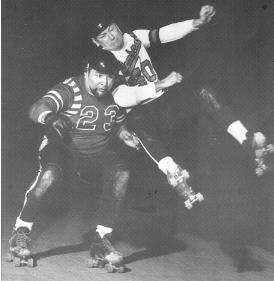
First let me give a brief history lesson that I learned from my derby bible, (Down and Derby) and set up the scene for modern roller derby. It was first trademarked by Leo Seltzer in 1935 when he combined dance marathons and roller skating and came up with a marathon roller race. Within the Chicago Coliseum people would skate the distance between New York and LA through laps on a banked track. By using both male and female competitors, he hoped to draw in more of a crowd, but it was seen more as a show instead of a sport. Add a little contact and a dramatic storyline and it was perfect for television starting in ’48. Leo passed the business to his son, Jerry, in 1959 and after a few rises and falls, it died in 1973.

Spandex. Blades. Elbows.
Welcome to RollerJam.
Enter the 80s. TV revived roller derby once again with an awkward love child of professional wrestling and American Gladiators, on skates. Rock-n-Roller Games was pure kitschy entertainment again with co-ed competitors and a banked style track and… an alligator pit? (Still can’t wrap my mind around that one.) That didn’t last long and then it popped up again in the 90s, but this time on rollerblades. RollerJam was seen more as sports entertainment, but still heavily scripted and corny.

All of these early versions of derby were motivated with the goal to sell a new version of entertainment and was often reliant on fickle television viewers. In the end, the melodrama outweighed the skill and people got over it quickly.

Finally in 2001 the beginnings of flat track roller derby began as some girls in Texas threw together a rough version of the game. Looking to the past they collaged together an all girl roller derby team that played on quad skates and a flat track. As a skater run endeavor, there was no third party to front the money to play or sign a television contract, the girls had only themselves to pull it off. Since a banked track is costly, time intensive to set up and needs to be stored, they adjusted the game to a flat track so they could play virtually anytime on any smooth, open surface.

After a few years of fine-tuning what began as a sport with a hint of sexy entertainment, roller derby began streamlining into the athletic version that is most practiced today. In 2004, with about 20 teams on the scene, the Women’s Flat Track Derby Association formed, and girls everywhere had a support system to look to when starting a team. 2005 began the first official set of WFTDA rules for flat track roller derby and has been updated every year to maintain a safe and fair skating environment as the sport evolves. To date there are 105 full member leagues and 46 apprentice leagues throughout the states, Canada and Europe as well as hundreds of WFTDA aspiring leagues all over the globe.

Anything goes in Renegade derby.
The first variant form of derby since the turn of the century would be Renegade leagues. In 2004, members of one of the earliest flat track teams, the Arizona Roller Derby, broke off to form the Renegade Rollergirls. This version essentially skates by no rules except for an aggressive Golden Rule standard and an “any surface anytime” motto. It was created with the desire for a fast paced game that wasn’t weighed down by penalties and highlighted the skaters’ skills. Three points are scored per lap, all sorts of blocks are allowed and refs aren’t needed. It results in a less complicated version of the game with an all out brutal twist. As of 2009 there are seven renegade teams.

In an effort to incorporate the older style of roller derby, the Old School Derby Association was formed in 2007 by the Penn Jersey She Devils. Combining older banked track with today’s flat track, they also aspire to have a less complicated game at high speeds, with aggressive action. OSDA developed a rule set in 2008, and can be played by men, women, and co-ed teams on banked or flat track.

The basic idea of the game is similar but the roles of jammer and pivot becomes a bit more interchangeable. After the first lap through the pack the jammer becomes “active” and can begin scoring points. Lead jammer status can change throughout the jam as it goes to which ever jammer is physically in the lead at the time. The pivot may take off and become jammer at anytime, especially if their jammer is in the box, but only one person may be scoring points at a time. The old school twist allows for triceps to be used in blocks, spin whips, and pivot blocks. (I still haven’t really figured out what the latter two really are…) Cutting the track, high/low blocks, tripping, and out of play penalties are all considered minors and result in one minute in the box. Things like deliberately pulling skaters down, fighting, biting, choking and kicking are majors and put a skater in the box for two minutes. An accumulation of eight penalty minutes ejects a player from the game. Currently eight leagues take part in the OSDA derby style.

Around that same time, Pioneer Valley’s Dirty Dozen, the New York Shock Exchange and Harm City Homicide, three men’s leagues, started the Men’s Derby Coalition to aid the interest men had in the flat track world. They don’t claim themselves to be a governing body yet, or associated directly with OSDA or WFTDA but do train and play by WFTDA standards. They started out playing alongside women, in exhibitions bouts at women’s bouts and scrimmaging against women, until they finally began holding their own double headers and tournaments. With about 11 MDC affiliated leagues they have their own tournaments and rankings within their growing support system.

This Is How I Roll - Working Trailer from Kat Vecchio on Vimeo.

A trailer for a documentary on men's derby and the opposition they face.

When Texas gave birth to modern roller derby, she really had two children. A split in the original revival resulted in two teams; the Texas Rollergirls, who remained flat track and the Texas Lonestar Rollergirls, who progressed as banked track team. Since then, a few more banked teams have popped up, but that trend remains slow and steady. The effort and space required for having and maintaining a banked track looks time intensive, and these teams often start as flat track teams until they have the means to switch to banked track. A recent visitor to our practice, Emma Grenade, came from the Arizona Derby Dames who recently made that switch. Her first time practicing flat track must have been quite the experience on our super slick floor, but the transition wasn’t too difficult for her. The World Organization of Roller Derby designed their banked track rules to be compatible with WFTDA rules so that skaters and refs may participate in either without being bogged down with too many differences. They play one minute jams, use their tricep to block, and skaters don’t visit the penalty box until after the jam ends. They also aren’t allowed to stop or skate backwards on the track for all you fans who are offended by “slow derby”…
Whip It featured banked track derby.

Some leagues like the San Diego Derby Dolls play both flat and banked, while others like the LA Derby Dolls play purely banked track. Episode #31 of the Derby Deeds podcast had a conversation with the Tilted Thunder Railbirds from Seattle about their recently acquired banked track. Through lots of research and hard work they began their team with a strong base of organization and planning, added LOTS of fundraising, and then finally built their very own banked track. From what I understood, they did not have flat track beginnings, but knew that they wanted banked track and did everything they could to make that possible. 

The evolution of roller derby throughout the years has affected all of the versions played today. Some people had looked back nostalgically and incorporated practices of what was. Others looked forward in an effort to emphasis the athleticism of women and how a made up game can be improved. It's truly amazing what people all over have created with their own hands, and I think that is the true spirit of every kind of roller derby that lives on today.

-L4D

Edit: Well, this post prompted more discovery! There is also "Derby Lite". A non contact version of women's derby that focuses on fitness. Check out this video to see more...