Tuesday, January 18, 2011

RDWC Week #2

The point of a challenge is that its supposed to be challenging, right? I think I like to give myself too many excuses and I need to just suck it up and do it! I suppose this is a consistent theme in my life, whether its doing that workout instead of napping, or applying for jobs I don't think I'm qualified for; I won't get results unless I try.

Meal and workout plans by day.
Last week when I started the Roller Derby Workout Challenge, I was also starting a new job at Target. It's still minimum wage but I should be able to get forty hours a week and still grab shifts at the coffee shop. It's just a stepping stone in my plan to someday get a career I've always wanted, because right now I just have to dig myself out money issues. Since Target has regulated breaks, it helps keep my meals in check, and also makes me think ahead. I was doing pretty good at eating the prescribed meals most of the week, and wrote out a menu on a white board for a quick glance at options. 

Later in the week I had some days where I was working at both jobs and was starting to feel a bit overwhelmed and started fudging portions and indulging in little sugary things. Then I was too busy to fit in a workout, or would just come home and pass out and forget to workout. I can take some pretty legendary coma naps, so instead of just "shutting my eyes for a second," I should get the workout done and then I can sleep all I want. 

It is going to be hard, and I'm sure nobody has an easy schedule. I like the food and I enjoy feeling strong and accomplished after a workout, so I need to just tighten up what I've already accomplished in one week. Maybe I can finally instill some good habits and stop listening to the sugar fairy every time she comes around. 

I already feel better and less bloated and have had compliments on how I look, imagine how I'll feel 7 more weeks from now! 
-L4D

Tuesday, January 11, 2011

Ace of Skates

If anyone has followed my blog long enough, my very first entry was recapping a mixer I participated in last year put on by the Quad City Rollers, and last Saturday they put it on again for the third year in a row. For those who don’t know, a mixer is hosted by a team (QCR) who invites skaters from multiple leagues (Old Capitol City Roller Girls, Des Moines Derby Dames, Eastern Iowa Outlaws, Circle City Derby Girls, Mad Rollin’ Dolls, Chicago Outfit, Rockford Rage, Stateline Derby Divas) and then mixes them up into new teams and has them bout in a shortened tournament style event. This year it was dubbed the Ace of Skates and the teams were the Bleeding Hearts (red), the Spiteful Spades (white), the Diamond Destroyers (green), and the Killer Clubs (black). The first two bouts were 20 minutes each, followed by a semi final bout that was 30 minutes long and a championship bout that was two 20 minute periods.

OCCRG's GLADi8HER on the jam line vs Sal Paralyze
from EIO. Standard impatient jammer pose.
In the first bout the Diamond Destroyers took on the Killer Clubs in what seemed like a pretty good match up. On the jam line first was OCCRG’s own GLADi8HER (Diamonds) and Ophelia Fracture (Clubs) who both got through multiple times during the full two minute jam, but Ophelia pushed the Clubs slightly further ahead. Sal Paralyze helped maintain this lead for awhile, but their walls quickly started to crumble as Glad, Lady Gotcha and Malice Munro rallied the Diamonds into a comfortable lead. 20 minutes went by quick, and as I was lining up for the second bout, I returned in time to see Glad break her toe stop off (for the second year in a row at this mixer) and skate about three or four grandslams with the damaged skate planted for fear of tripping without the usual support under her toe. It was quite the image to see her pushing along like she was on a skateboard, toe stop in hand, showing that derby girls don’t quit. Diamonds won 87 to 51.

Bloody Elle is a relentless force.
My team, the Spiteful Spades were up next against the Bleeding Hearts, who I so lovingly call Team Douchebag. I’m not quite sure what the logic behind choosing teams for mixers is, but Team Douchebag was quite obviously stacked with some of the best skaters from the area. They had the quick feet of Pink Taco and Stella Italiana combined with the blocking force of Bat R Up, Jen Detta, Animal Mother, Dead Lee Danni, Bloody Elle, QC Banshee and more. We had two skaters from our roster drop out which put our alternate in, Sugar and Slice, but she has been recovering from a sore knee and her jamming was kept minimal.

Crazy Legs vs the Kraken. Legs win.
Seeing what we were up against, our only point of strategy was to try and play together as well as we could. Teamwork is the challenge of a mixer because you are playing with skaters of various skill levels and experience, which reminds you how important it is when you’re skating with your own league. I found that I often ended up at the back, blocking alone and would turn into one of my own players as I watched Stella fly around the outside. The Douchebags worked together a little better than I anticipated as they totally shut us down by trapping a skater from our team when our jammer was in the box. It was frustrating so I tried to do my best while jamming which usually meant getting lead and calling it off before they could score more points. Graves tried to score more for us as well, but she was spending too much time in the box. A Few Screws Lucy, with her sparkly leg warmers, reluctantly took the jamline and gave it all she had, but we just could not keep it together against such a heavy hitting team. I should note however, once while I was jamming, Bat R Up tried her best to take me out, but I threw my hip back at her and she ate my dust as I sped away from the pack. It’s the small victories that you have to be proud of.

After losing 71 to 20, we went on to the semifinal for our 30 minute bout against the Killer Clubs. I was glad we were playing right away since I was still pumped up and looking to skate harder and faster. I felt we would have had more of a chance against them, but instead we decided to play a lovely game of musical chairs in the penalty box, which I somehow stayed out of all night. Mixers result in a little bit messier play since the skaters are out of their element, so there were lots of pile ups and accidental tripping. It’s just not as pretty. I don’t remember much from this bout as we quickly slid into a funk and lost 139 to 35.
Few Screws Lucy vs the world. The rest of white in the box, but she still knocks Ophelia out on her own.

That left the final bout, Team Douchebag versus the Diamond Destroyers. I spent most of this bout booing and explaining things to our fresh meat, so I didn’t pay attention to much of the action. The Diamonds gave it all they had but the Douchebags undoubtedly smashed their way to the top, 149 to 59.

It was a frustrating experience, but by the end of the night I had met interesting skaters and had people I didn’t know telling me I was awesome. The after party was a blast, and some of our fresh meat even joined us on the dance floor, proving they were real OCCRGs. Derby, dancing, and pizza; what more could you ask for?
-L4D
Pictures by Joy Doehrmann.

Monday, January 10, 2011

Roller Derby Workout Challenge Week #1

So not only have the Angel City Derby Girls from LA created a workout video, they also have the Roller Derby Workout Challenge! They consulted experts and came up with an 8 week plan complete with workouts and meals that will whip girls into shape. From trying many diets and reading lots of articles about food, I have a basic understanding of what it takes to eat healthy, I'm just too lazy to do it. With specific guidelines and having meals spelled out for me, I'm hoping this will be just what it takes to kick me into a consistent healthy habit. It looks like it will be a lot of work, but totally worth it.

Each week they also have "homework assignments" which are a handful of questions you answer in a note on Facebook, and then post the link on the group's discussion board. If you complete and post each assignment, it puts you in a drawing to win sweet derby prizes. I am going to try to post them here as well, and keep a workout diary to make sure I stay on top of things. It will also give me the added pressure of an audience (the large reader base that I pretend I have) watching to keep me going.

I'm already behind due to my financial situation and not being able to go to the store yet, but that should be fixed tomorrow, and with my new job at Target starting soon I should be making the ends meet a little easier. So here we go...

Week #1 

1) What do you think will be the hardest nutrition guideline for you to follow?
I think just getting used to cooking and preparing and all the work that goes into eating healthy. When I work at the coffee shop it'll be hard not to eat all the sweet treats around me! So, I guess sugar will be hard to drop a bit. 

2) We want you to think before you eat, do you think before you shop?? Name three derby owned businesses.
Wicked! Sin City! Fast Girl Skates! 

3) What is one thing that you have in your fridge or pantry that you thought was healthy but may now be rethinking?
I guess the 1/2 fruits kinda threw me off. I thought everything about fruit should be good, but I guess they have calories and natural sugars too. And I never thought about whether my peanut butter was sweetened or not. 

4) Do you know your league history? Who founded your league and in what year?
Huzzie and Killa started our league in the fall of 2008! Started so small and grown so much!

5) How did you come up with your derby name?
I threw around a lot of ideas with some friends. My last name is Edwards, so it worked as Deadwards and then came up with Left 4 Deadwards even though I've never played the game, but I am fond of zombie stuff. 

6) Attach a photo to your note that conveys how you feel going into this challenge. It can be of you, or of an object, or something you find on the web.
I participated in a mixer hosted by the Quad City Rollers 2 years in a row. I was so out of shape last year. I've come a long way since then, but I have a gut I could get rid of, and endurance I can improve, etc. etc. It just gives me a bit of confidence of how far I've come which means I can do that much better. 
Mixer 2010 and Mixer 2011.
I also took some before pictures... that I will NOT be sharing but they definitely gave me the added boost of motivation to get going. Are you up for the challenge?

-L4D

Sunday, December 26, 2010

Stuck Between College and a Job Place.

1 of 12 portraits I drew of my college roommate
for a class at the U of I.
‘What do you want to be when you grow up?’ is a question posed to children probably every year after they start their educational career. The answers go through phases of reality. First are the imaginative princesses and cowboys, then the lofty presidents or rock stars and finally the more obtainable veterinarians, teachers or firefighters. By the time I wanted to be a vet, I was probably in fifth grade and that decision was based on the fact that I liked animals. Then I realized what vets really did and quickly changed my mind.

At a certain point, enough people praised me for being artistic and I liked to draw so… that was it. I was to be an artist. Later I also thought I would become a writer. Or a psychologist. Oh, maybe a journalist! My focus kept coming back to and remaining loosely on art so I started at community college to “figure it out” before I made it to a larger university. I apathetically took a variety of classes and left with an AA degree and still no concrete plan. I chose the University of Iowa next because Iowa State was too design oriented and I wanted to get into a “real" art program. My next grand idea was to become a photographer because that could have both practical and artistic futures. So I took a class but decided photo majors took themselves too seriously. As filler, I had taken an Intermedia class which I ended up liking and graduated Iowa with a BFA in.

I’m all “grown up” now and it has gotten me zero job and plenty of debt. I went through the cycle of school with just enough planning to keep me moving to the next thing, but then school ran out and I’m left wondering “what’s next?” That has since then snowballed into a deeper thought process about life. Thinking of it on a purely primitive level, we are created to procreate and raise a family. The cycle of life goes on and on, but that can’t be the point of it all, can it? The typical American values are kind of lost on me, marriage and kids, and working a 9-5. This typical mainstream livelihood just depresses me, especially when I’m constantly being surrounded with examples of marriages that don’t stick and seeing people whose personal problems stem from their parents. So my conclusion is that the point of life is to create a place in this world just for me and my happiness.

So what makes me happy? Currently I make coffee for minimum wage and never fill a forty hour workweek. It’s easy and flexible, but I struggle to make ends meet and let’s not think about the debts I need to pay off. It’s depressing and frustrating and hopeless, but I survive because I also play roller derby in the meantime.
I don't know how they put up with me, really.
Ah, roller derby. It’s starting to become a cliché it seems, that “roller derby saved my life!” But I know without it I would be completely lost and alone. Everyone I know, hang out with, and even live with is someone from my derby world. It gives me something to think about, plan for, and create for. I never wanted to be a teacher or anything that required me to interact with lots of people. I didn’t want anything to do with commercial art because I thought it was too technical. I was always told I was artistic and creative but never fully believed in it, so I never pushed myself to really become an “artist.” Now derby has dumped all my absolutes at the door, and left me wondering what I really want to do with my life.
Creating some of the posters for the
team has made me want to take some
design classes.

I went through seventeen years of school and never fully committed to anything I wanted to be, and then in two years of roller derby I’ve come to a few conclusions:
I enjoy a full contact sport. 
I would be in heaven if I could wear only leggings the rest of my life.
I actually can get along with women. 
I like design, networking and advertising after all.

I can only play a bone breaking sport for so long, but now I have a better idea of what else I can be passionate about. It has led me to think about taking some more classes and striving for a practical job that I actually want. I've just been doing things to do things and when I pictured myself at thirty recently, it was blank. It’s kind of nice to live day to day and do only enough to get by, but I like the idea of living above the surface instead of floundering below it.

 I also became one of the coaches for our fresh crop of new skaters. It’s not a position I had pictured myself doing, as it falls into the category of teaching and that was something I had crossed off my list long ago. The opportunity presented itself and I found myself really wanting to do it. The whole teacher thing finally clicked with me, that when it’s something you are passionate about, you want to share with other aspiring people the knowledge you have.
Running some dryland footwork drills with the fresh meat.
I have always had ideas about life… goals and aspirations, but they never really seemed to make it out of my head. It seems that in this recent assessment of my life, the whole world has opened up. I realize that all I have been doing is bitching and moaning and suggesting to myself how life should be instead of taking action to achieve it. I have got to take a cue from Left 4 Deadwards and just dive into the rest of my life head first. I know I have the potential to do everything I want, I just need to shut up and do it.

-Deadwards

Monday, December 6, 2010

Roller Derby (R)evolution.

When I tell people I play roller derby I often get a range of confused reactions. There’s the “Really?? You get to elbow girls and stuff?” or the “Wow, that’s so cool! Do people get hurt a lot?” and you can’t forget the blank stare “What’s that?” In the last year though, I’m more likely to get a “Oh! Like in Whip It?” At first I would just kind of nod my head but explain that we play flat track and it’s a bit different, and plus that movie didn’t really highlight the …well never mind. Eventually I just started saying “Yeah! Like the movie...”

I know I have turned into a bit of a derby snob and am just a wee bit tired of answering the same uninformed answers again and again, but I have to remind myself that the general public just doesn’t know any better. Roller derby is so new (I feel like I say this every post) that the small percent who may know what it is, may not know everything about it or even that there are multiple organized versions of modern derby. I didn’t even know this until recently and it kind of gives some insight into how the prevalent form, flat track roller derby, got to where it is today.

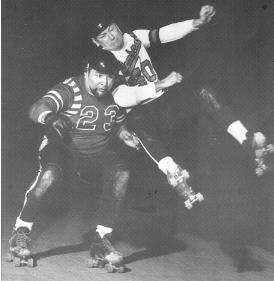
First let me give a brief history lesson that I learned from my derby bible, (Down and Derby) and set up the scene for modern roller derby. It was first trademarked by Leo Seltzer in 1935 when he combined dance marathons and roller skating and came up with a marathon roller race. Within the Chicago Coliseum people would skate the distance between New York and LA through laps on a banked track. By using both male and female competitors, he hoped to draw in more of a crowd, but it was seen more as a show instead of a sport. Add a little contact and a dramatic storyline and it was perfect for television starting in ’48. Leo passed the business to his son, Jerry, in 1959 and after a few rises and falls, it died in 1973.

Spandex. Blades. Elbows.
Welcome to RollerJam.
Enter the 80s. TV revived roller derby once again with an awkward love child of professional wrestling and American Gladiators, on skates. Rock-n-Roller Games was pure kitschy entertainment again with co-ed competitors and a banked style track and… an alligator pit? (Still can’t wrap my mind around that one.) That didn’t last long and then it popped up again in the 90s, but this time on rollerblades. RollerJam was seen more as sports entertainment, but still heavily scripted and corny.

All of these early versions of derby were motivated with the goal to sell a new version of entertainment and was often reliant on fickle television viewers. In the end, the melodrama outweighed the skill and people got over it quickly.

Finally in 2001 the beginnings of flat track roller derby began as some girls in Texas threw together a rough version of the game. Looking to the past they collaged together an all girl roller derby team that played on quad skates and a flat track. As a skater run endeavor, there was no third party to front the money to play or sign a television contract, the girls had only themselves to pull it off. Since a banked track is costly, time intensive to set up and needs to be stored, they adjusted the game to a flat track so they could play virtually anytime on any smooth, open surface.

After a few years of fine-tuning what began as a sport with a hint of sexy entertainment, roller derby began streamlining into the athletic version that is most practiced today. In 2004, with about 20 teams on the scene, the Women’s Flat Track Derby Association formed, and girls everywhere had a support system to look to when starting a team. 2005 began the first official set of WFTDA rules for flat track roller derby and has been updated every year to maintain a safe and fair skating environment as the sport evolves. To date there are 105 full member leagues and 46 apprentice leagues throughout the states, Canada and Europe as well as hundreds of WFTDA aspiring leagues all over the globe.

Anything goes in Renegade derby.
The first variant form of derby since the turn of the century would be Renegade leagues. In 2004, members of one of the earliest flat track teams, the Arizona Roller Derby, broke off to form the Renegade Rollergirls. This version essentially skates by no rules except for an aggressive Golden Rule standard and an “any surface anytime” motto. It was created with the desire for a fast paced game that wasn’t weighed down by penalties and highlighted the skaters’ skills. Three points are scored per lap, all sorts of blocks are allowed and refs aren’t needed. It results in a less complicated version of the game with an all out brutal twist. As of 2009 there are seven renegade teams.

In an effort to incorporate the older style of roller derby, the Old School Derby Association was formed in 2007 by the Penn Jersey She Devils. Combining older banked track with today’s flat track, they also aspire to have a less complicated game at high speeds, with aggressive action. OSDA developed a rule set in 2008, and can be played by men, women, and co-ed teams on banked or flat track.

The basic idea of the game is similar but the roles of jammer and pivot becomes a bit more interchangeable. After the first lap through the pack the jammer becomes “active” and can begin scoring points. Lead jammer status can change throughout the jam as it goes to which ever jammer is physically in the lead at the time. The pivot may take off and become jammer at anytime, especially if their jammer is in the box, but only one person may be scoring points at a time. The old school twist allows for triceps to be used in blocks, spin whips, and pivot blocks. (I still haven’t really figured out what the latter two really are…) Cutting the track, high/low blocks, tripping, and out of play penalties are all considered minors and result in one minute in the box. Things like deliberately pulling skaters down, fighting, biting, choking and kicking are majors and put a skater in the box for two minutes. An accumulation of eight penalty minutes ejects a player from the game. Currently eight leagues take part in the OSDA derby style.

Around that same time, Pioneer Valley’s Dirty Dozen, the New York Shock Exchange and Harm City Homicide, three men’s leagues, started the Men’s Derby Coalition to aid the interest men had in the flat track world. They don’t claim themselves to be a governing body yet, or associated directly with OSDA or WFTDA but do train and play by WFTDA standards. They started out playing alongside women, in exhibitions bouts at women’s bouts and scrimmaging against women, until they finally began holding their own double headers and tournaments. With about 11 MDC affiliated leagues they have their own tournaments and rankings within their growing support system.

This Is How I Roll - Working Trailer from Kat Vecchio on Vimeo.

A trailer for a documentary on men's derby and the opposition they face.

When Texas gave birth to modern roller derby, she really had two children. A split in the original revival resulted in two teams; the Texas Rollergirls, who remained flat track and the Texas Lonestar Rollergirls, who progressed as banked track team. Since then, a few more banked teams have popped up, but that trend remains slow and steady. The effort and space required for having and maintaining a banked track looks time intensive, and these teams often start as flat track teams until they have the means to switch to banked track. A recent visitor to our practice, Emma Grenade, came from the Arizona Derby Dames who recently made that switch. Her first time practicing flat track must have been quite the experience on our super slick floor, but the transition wasn’t too difficult for her. The World Organization of Roller Derby designed their banked track rules to be compatible with WFTDA rules so that skaters and refs may participate in either without being bogged down with too many differences. They play one minute jams, use their tricep to block, and skaters don’t visit the penalty box until after the jam ends. They also aren’t allowed to stop or skate backwards on the track for all you fans who are offended by “slow derby”…
Whip It featured banked track derby.

Some leagues like the San Diego Derby Dolls play both flat and banked, while others like the LA Derby Dolls play purely banked track. Episode #31 of the Derby Deeds podcast had a conversation with the Tilted Thunder Railbirds from Seattle about their recently acquired banked track. Through lots of research and hard work they began their team with a strong base of organization and planning, added LOTS of fundraising, and then finally built their very own banked track. From what I understood, they did not have flat track beginnings, but knew that they wanted banked track and did everything they could to make that possible. 

The evolution of roller derby throughout the years has affected all of the versions played today. Some people had looked back nostalgically and incorporated practices of what was. Others looked forward in an effort to emphasis the athleticism of women and how a made up game can be improved. It's truly amazing what people all over have created with their own hands, and I think that is the true spirit of every kind of roller derby that lives on today.

-L4D

Edit: Well, this post prompted more discovery! There is also "Derby Lite". A non contact version of women's derby that focuses on fitness. Check out this video to see more...

Saturday, November 20, 2010

Slow Derby Sucks?


Attending the 2010 WFTDA Championships in person was an overwhelming and exciting experience. Some of the best teams from around the country had gathered to battle it out. Teams whose athletes had worked tirelessly on their own time to build endurance, agility, and explosive muscular strength so they could compete, on wheels, for an hour of full contact chaos. I was thrilled to enjoy a whole weekend of derby up close and watched in awe as skaters I aspired to be took each other on, and they were getting… booed?

As the weekend went on, “Slow Derby Sucks” t-shirts started circulating through the UIC Pavillion and people had signs that either stated the same, or demanded skaters to skate fast. Anytime there was stalled, stopped or slow action on the track, the crowd went crazy, heckling and booing the skaters. Crowds can be very fickle depending on where their loyalties lie, and booing is usually reserved for the referees. I couldn’t understand why the crowd had become so antagonistic towards the skaters in general.

My first frustration with this aggressive attack on a style of play is that it is a generalization of action on the track. My assumption then is that perhaps most people booing may not even know the thought process behind some of these strategies. What is “slow derby” anyway? The website behind the crowd's response, slowderbysucks.com states: "Slow derby is when skaters slow down, completely stop on the track, or skate backwards or clockwise (in the opposite direction)."  Queen of the Rink recently posted about the website and a comment to the post had it right in saying there should be “three separate conversations about three discrete tactics:
1. Delaying the Jam Start.
2. Pushing a skater out, then skating clockwise to force her to come in behind you
3. Generally keeping a slow pace for the pack.”
(A thanks goes to “Ryan” for bringing up this great point.)

Delaying the jam start is when the whistle blows, yet all of the defined pack does not cross the pivot line, thus delaying the jammer’s whistle and wasting the clock. A team may do this because they have the lead and want to burn the minutes that the other team could spend scoring points. They could also do this if they have a blocker, or worse yet a jammer, in the box and want to stall so that their teammate can finish her penalty and join them on the track. It could also be a ploy to confuse or disrupt the other team in order to establish position and control the pack.
Gotham tried skating backwards to create no pack but
Philly moved with them to keep stalling the whistle.
A player may not re-enter the track in front of a skater who knocks her out of bounds, so often the initiator may slow down or stop to slow the movement of the out of bounds skater, forcing her to come in play directly behind her. This has been a common sense strategic move for awhile, but the first time I saw someone skate backwards to force the other skater back further had me nearly peeing my pants. It is such a satisfying maneuver to execute and works especially well against the opposing jammer. The whole point of defense in roller derby is to stop the other jammer from scoring points, and this tactic keeps them out of the pack longer, thus scoring no points. A blocker has to exercise precise movements in order to not fall out of bounds herself, while also keeping an eye on the pack because she must stay in play in order to contain the opposing skater.
A Charm City girl knocked the Minnesota jammer
to the inside and slows down.
Keeping a slow pace in the pack throughout a jam is often reserved for power jams. When the opposing jammer is called off the track, you would want to trap one of their blockers (called a goat) and slow them down to force the rest of the pack to slow down as well. If they don’t they will become out of play and if there is no goat and the two teams split, there is no pack. Slowing the pace allows for your own jammer to make as many five point passes as she can (a grandslam), and leaves the other team scrambling to regain control. There is also a flip side to this strategy. If your own jammer gets sent to the box, you would want to immediately speed up the pack so that the jammer can barely make it through the pack, or not at all. In this fast pack situation there may be little to no hitting or action because the opposing team is just working on trying to catch up. 
Philly traps a Kansas City Roller to help their jammer score points.

The main argument slowderbysucks.com puts forth is that “slow derby” is lazy. To me, as a skater, slowed action intensifies the game. The explosive muscles and agility of starting and stopping and avoiding skaters is at its height more than it ever is in a fast pack situation. A jammer has to be decisive in order to not backblock and blockers are straining to hold position or lean another player out. They also have to keep mental notes of where the pack is, what direction they are skating when they engage, where the jammers are, or if they are keeping a solid wall. To slow or stop and confront the opposing players instead of just skating away from them takes a lot of precise skating and judgment. There is definitely a subtly to this kind of action but I would not call it lazy.

Roller derby is still in its infancy and is growing and evolving all the time. Since the first shared rule set in 2005, derby has gone through many growing pains and revisions. In its fifth edition I believe it has finally developed into a concise yet detailed guideline for the game and will only require small tweaks from here on. The lure of roller derby has always been short skirts, fishnets and hard hits, but as these women cultivate the sport, it becomes more and more purely an athletic endeavor with a feminine shell. Those things all still exist in derby, but the boutfits I saw at Championships were more uniform and streamlined. Skaters still have some of their own certain flair, but most teams just looked solid and well put together on the track.
Gotham looks like a well-oiled machine in just their warm ups.
The game itself has even streamlined and become more about how the game is played and not just the show. Dive bomb hits and explosive take outs have been traded in for booty blocks and effective leans. Skaters are realizing that it does their team no good if they take themselves out with the opposing skater. It is becoming about position on the track and a balancing act of offense and defense, not just an all out war. Big hits are becoming equal to the slam dunk in basketball; it’s a crowd pleaser, but not necessary to the game. Are fans going to stand up in outrage because skaters are using more positional blocking then all out hits?

It’s not that I am advocating that roller derby should become all about slow play, but there’s just something that rubs me the wrong way about this aggressive response and being demanded to play derby a certain way. I get that watching girls standing on the track may be boring or frustrating to watch, but I also get the strategy behind it. There are times that it be used excessively but I feel that as teams experiment with these tactics more and more, they will figure out what works and what is worth it to their game. There were many times I saw it used effectively at Championships and the skaters switched so quickly between tactics that no one hardly noticed. There were also times when it ultimately failed and a team wasted thirty seconds for nothing. The skaters will either become more effective with their use of these strategies, or drop them all together.

The Mad Rollin' Dolls all take a knee to keep
Philly from stalling on the line.

The only change I could see happening would be something equivalent to a shot clock on the start lines. A team could potentially stall a jam for a whole two minutes, which would be ridiculous, but the rules wouldn’t stop them. Stalling for ten seconds to gain another player or jammer on the track seems reasonable, but anything much longer seems a bit excessive. Skaters are already figuring out how to counter act this ploy by kneeling on the line before the jam even starts. If they do it before the whistle there is no pack and no penalties issued, and the jam whistles sounds right away. 

The rest of it is just smart derby. Most of the fans who watch derby are new to the sport and don’t understand all the rules or action on the track. There are lots of die-hard derby fans as well who have been following the sport and are frustrated with these trends in the strategy.  I hope as the sport moves forward, the fans will be patient as it evolves, and have a deeper understanding of what they are watching and be just as passionate.

Playing to the crowd is a double edged sword. Yes, their support helps us keep our DIY system going, and bouts scheduled, but when it comes down to it skaters aren’t being paid. They are there because they want to play and they are in love with the sport of derby. If there were no fans that would not necessarily kill the game for us. I would still strap on skates and find a gym and scrimmage with my teammates for as long as my would muscles would allow. Derby still runs a fine line between being seen as a sports endeavor and as mere entertainment. (Check which section your local newspaper puts the story about your team in; was it the sports or the arts & culture? Kudos to Animal for pointing that out.)

I'm glad fans are taking roller derby so seriously, but it just seems like a selfish argument and I don’t like being told how to play the game. I think the best solution would be to start a discussion, not a petition. The whole campaign of slowderbysucks.com just screams propaganda and feels too political by forcing people to “choose sides” or act outrageously. Roller derby today has democratic principles that propel the mantra of “by the skaters for the skaters,” and it will be the skaters who have the final say. I think the more knowledge and discussion the better, get the conversation started.

-L4D

*Speical thanks to everyone I've chatted with in the last few weeks about this, you helped form these thoughts. Keep on talking.

Monday, November 15, 2010

"It Ain't Like Being There!"

As a newly inducted apprentice league, getting a glimpse last weekend at the WFTDA Championships was inspiring to say the least. I have watched some of those same teams play on DNN boutcasts, but as their slogan goes, “it ain’t like being there!” Seeing all sorts of different teams, vendors and fans was overwhelming and exciting; so many people brought together for the love of derby. I realized how small our team is in the derby world, but also that there are no limitations but the ones you set yourself.

The Hydra, Championship Trophy
named after a founding member of WFTDA
The twelve teams I saw play in three days in Chicago all average about five years of bouting experience and represent all areas and styles of play around the country. Finishing our first full season, and second year of bouting means potentially in three years we could be on the track with some of these teams. Every year derby seems to keep evolving and teams all over are pushing the game harder. The Hydra went to Rocky Mountain this year, with the previous champions, Oly taking second, and Gotham, the 2008 champions, taking third.

Since the recent epidemic of roller derby began in Texas and spread to the coasts, it seems like the middle of the country is still at a lower level of playing. Watching Gotham and Oly play was like watching majestical creatures glide smoothly across the track, and weave effortlessly through the pack. The 2 and 3 seed teams seemed a bit more awkward in comparison, but any WFTDA team seems to be leagues ahead of any team we see here in Iowa. Since derby is still so new, the level of skill varies because teams have to discover on their own time how to excel and improve. I knew Minnesota, Madison and Nashville would probably not make it past Friday, but their tenacity and determination did surprise me. Although they each lost by over 100 points, they were there to prove they wanted it, and were not going to give up without a fight.
Hugs all around after the Minnesota vs Charm City bout. 
We got to the UIC Pavillion a little late Friday and missed the first team to be eliminated, the B.ay A.rea D.erby Girls, who played the Texas Rollergirls. It sounded like a good match up after seeing the low score of 72 to 59, a win for Texas, but I was most excited to see our Minnesota friends play next. They started out strong, but struggled with Charm’s solid control of the pack. MNRG’s Psycho Novia had insane footwork, as she seemed just cut through the pack like butter. I was surprised they didn’t jam Jukebox more, and didn’t realize until later that Vuedoo wasn’t playing due to injury. The floor also looked pretty slick, and after skating on Minneasota’s sticky home turf at bootcamp, I bet they were thrown off by the surface. They ended up losing 119 to 249. The other two bouts were kind of blow outs after the first half; Philly 213 to Mad 53 and Oly 214 to Nashville 53. (And very oddly similar in scores.)

Suzy Hotrod at full go.
The second day was a full day of derby with six bouts that upped the intensity. The Gotham Girls beat out Texas 151 to 52 with a very fast paced and skillful game. There were few penalties and both teams played very smart. I haven’t really seen Texas play much, so I mostly paid attention to Gotham, and of course Bonnie Thunders and Suzy Hotrod. Their jamming style is breathtaking and I hope I absorbed their skills through my eyes.

I was excited for the Rocky Mountain vs Charm City bout which upped the intensity even more. I have had my eye on Rocky since the Western Regionals where they upset Oly’s 22 straight win record, taking first place. They have a sassy sort of playing style, which also leads them to be prone to more penalties. A jaw dropping YouTube video of Urrk’n Jerk’n has me swooning over her sweet jamming skills and Amanda Jamitinya gets my love for her blocking (and her name). Charm’s tight pack control couldn’t reign in Rocky, and they lost 103 to 165. It was this bout that we saw our first ejected player of the weekend, Dolly Rocket from Charm.

Philly played Kansas next, which I was curious to watch since apparently I know nothing about Kansas, or any other South Central team. I believe it was this bout we saw a lot more of the kneeling on the line to counter act slow pack. If it is done before the whistle there is no pack, and no one receives a penalty as the jammers are then released right away. It also gives less time to gain control of the pack, but I could go on all day about the variables that apply to strategy. This bout also was high in penalties as I saw both teams’ jammers go to the box twice in one jam. It ended with Philly on top, 147 to 126.

The Oly Rollers were up next to play Windy City on their home track. Day two of the tournament resulted in a much more packed Pavillion since it was a Saturday, and a majority of those seats sounded like they were filled by Windy fans and they were very vocal with their support. This was another fast game and after Windy gave it all they had, they lost to Oly 76 to 178.
There wasn't a bad view in the whole UIC Pavillion.

I was looking forward to the next bout which put Gotham against Rocky, and it didn’t disappoint. My assumption was that Rocky would give Gotham a run for their money, but would still not overcome the seemingly untouchable New York team. That was not the case. Rocky dominated the first half but started to lose their lead to penalties in the second. The Rocky jammers had a hard time since they could only keep two blockers on the track at a time, which also didn’t provide help against the quick feet of Suzy and Bonnie. They started to look frustrated but pulled themselves together long enough to skate away with their second win, 113 to 79. The last bout had Oly vs Philly and as the previous year’s Champions, I was correct in assuming Oly would come out on top, 106 to 81.

After such an exciting Saturday, it was kind of sad to only have two bouts to look forward to on Sunday. Gotham went up against Philly for third place in a battle of Eastern teams. The first half kept it pretty close but Gotham’s fast game seemed to win it out in the end. Philly seemed to utilize the slow starts a little more which epically failed at one point. Their pivot was in the box and they managed to stall the line for about thirty seconds to get her back in. She then failed to re-enter the pack from the back and was sent back to the box for an illegal procedure. After wasting the clock and lots of booing, they didn’t even accomplish their goal. Philly just couldn’t keep their blockers together and lost 51 to 162.

Now the whole weekend had come down to Rocky Mountain vs Oly, a battle of the West. I think most people assumed Oly would win it all for the second year in a row, but Rocky was the only team they lost to in Western Regionals (86 to 127), so it appeared to be an exciting rematch. That would be an understatement.

I apparently took no notes of this bout because I gave it my full attention. Rocky started out dominating the pack, but lost their lead again due to penalties and not being able to keep a full pack on the track. When playing a team of speed skaters, that is not a situation you want to be in. I was nearly convinced they had already lost it, but they managed to bring themselves back into the lead late in the game.

Everyone is on their feet for the last jam of the weekend. 
What seemed to be the last jam of the night, started with Tannibal Lector from Oly on the jam line by herself. She made grand slam after grand slam, and pulled their score ahead of a scrambling Rocky. Although, by the end of the jam, Tannibal back blocked, sending her to the box as Frida Beater snuck back on the track to score a few points for Rocky. With only 20 seconds left on the clock, Rocky called a timeout in order to fit another jam in. (Another strategy of trickery.)

Now the tables had turned and Rocky was setup for a power jam with only two blockers from each team in the pack, and Frida lining up to jam again. She got through as lead, and came back around for her first grand slam as blockers from the penalty box started to return to the track. She barely made it through another time and looked up at her jam ref, and then the scoreboard… Rocky pulled ahead by ONE point. She called it off and the place was at full roar as we all stared down the scoreboard to make sure the score was official.

Rocky won it 147-146.

Go Go Berserk from the Quad City Rollers caught the last two jams on video so you can relive the insanity...

-L4D